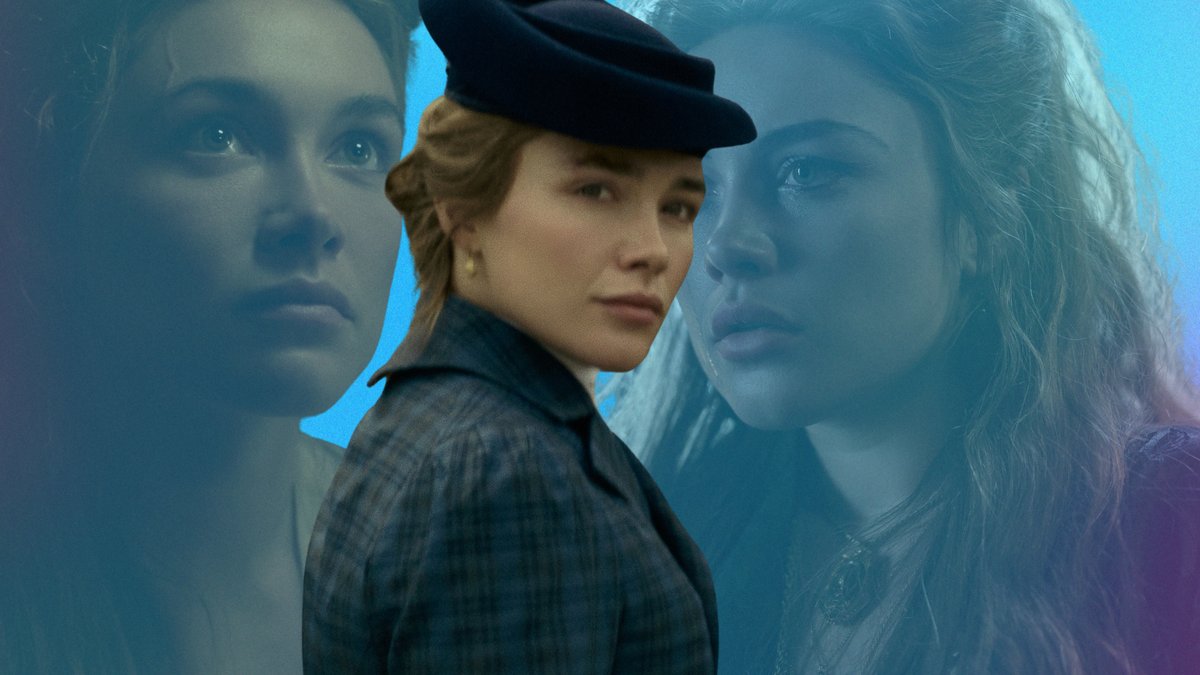
Florence Pugh has dismissed the notion that Cathy Ames, her role in Netflix’s East of Eden, qualifies as a straightforward villain. The character—a figure who murders, manipulates others, and abandons those closest to her—has divided critics since the series debuted, with some viewing her as a purely monstrous force and others seeing her as a victim of systemic abuse. As both the actress and executive producer of the adaptation, Pugh expressed strong protective instincts toward Cathy, though she stopped short of defending the character’s actions.
The series, directed by Zoe Kazan, reinterprets John Steinbeck’s novel by centering Cathy’s childhood rape as the catalyst for her psychological collapse. While Steinbeck’s original work portrays her as a sadistic figure, Kazan’s version presents her as someone fundamentally shaped by violence. “We’re watching someone in real time have knee-jerk reactions to the world that she has been brought up in,” Pugh explained. “That is what will make the audience feel a bit conflicted about the moments that they despise her and the moments that they might like her.”
Read Also: Student Post Validates Cornell Survivor’s Assault
Cathy’s descent in the show is brutal. She poisons an elderly woman to seize control of her brothel, abandons her twins after an affair with her husband’s brother, and drives a man to suicide. Yet Pugh argues that Cathy’s cruelty stems from a history of systemic abuse. “I don’t think you can ask someone that was raped as a child to go through life normally,” she stated. “I don’t think you can ask a woman who’s battered within an inch of her life to feel safe around men anymore.”
Trauma vs. villainy: Why Cathy’s cruelty feels inevitable
Critics have accused the adaptation of softening Cathy’s villainy, but Kazan rejects that interpretation. Steinbeck himself wavers; he calls her a monster, then later admits he’s unsure if that label is fair. The director emphasized that Cathy’s selfishness and cruelty aren’t excuses but context.
Pugh’s portrayal demanded extreme physical and emotional commitment. She described pushing her body to its limits, both on and off screen, to embody Cathy’s trauma. “I asked my body to go through those things, you know?” she said. “I think playing Cathy has been one of the hardest jobs that I have had the opportunity of playing.
Read Also: Charlotte Tilbury cuts prices during Amazon Big Deal
I gave a lot of myself to play this character, and it’s no wonder that I feel protective of the character that’s what happens,” she says. “You become attached to them in some way, and a bit of them rubs off on you, and a bit of you rubs off on them, and that’s what happens when you are so tightly linked to these characters.”
The series forces viewers to confront a difficult question: Can a person be both monstrous and sympathetic? Cathy’s actions are beyond redemption, yet her backstory complicates easy moral judgment. Pugh argues the adaptation doesn’t seek to justify her but to examine how trauma warps morality. “It’s okay to feel both things because humans are all of those things. We are deeply flawed, and then we are also beautiful people,” she says. “She’s not supposed to be just evil. She’s not supposed to be just bad. She is a whole human.”
No feminist hero: The limits of Cathy’s moral ambiguity
Kazan’s adaptation deliberately avoids positioning Cathy as a feminist figure, despite modern audiences’ tendency to retroactively apply contemporary values to historical characters. This refusal to sanitize Cathy’s selfishness, her disregard for others’ suffering, her lack of solidarity with women in her brothel, makes her morally ambiguous. The series suggests her cruelty originates not from political awareness but from a belief that survival demands ruthlessness.
Read Also: Latine Influencers Build Brands Beyond Social Media
Yet that same ruthlessness makes her compelling. Cathy’s actions, poisoning, manipulation, murder, aren’t ideological but self-serving. She steals, betrays, and destroys without remorse, yet her backstory explains why she operates outside moral boundaries. The adaptation challenges viewers to determine whether trauma justifies such extremity or simply provides context for her inhumanity.
A lone figure: How Cathy’s choices seal her fate
The series’ final scenes emphasize Cathy’s isolation, a direct result of her choices. After abandoning her twins, she wanders the desert alone, stripped of power and purpose. This moment contrasts with her earlier dominance, suggesting even her greatest triumphs leave her empty. The adaptation doesn’t offer redemption but presents Cathy as a warning about the consequences of unchecked trauma. Her story forces audiences to grapple with the question of whether any human being, even one shaped by such profound suffering, can ever escape the cycle of violence they’ve been raised in.


